Introduction
The Bureau of Indian Standards (BIS) is the national body, that undertakes standards setting and provides quality certification in India. It was also established under the BIS Act 1986. Primarily, the aim is to have a check on products to ensure that they satisfy defined safety and quality standards to further protect consumers and also to encourage fair trade. At present, with the increasing Indian market, BIS certification is of prime importance for enterprises—both domestic and overseas— to gain assurance about the safety and reliability of the products.
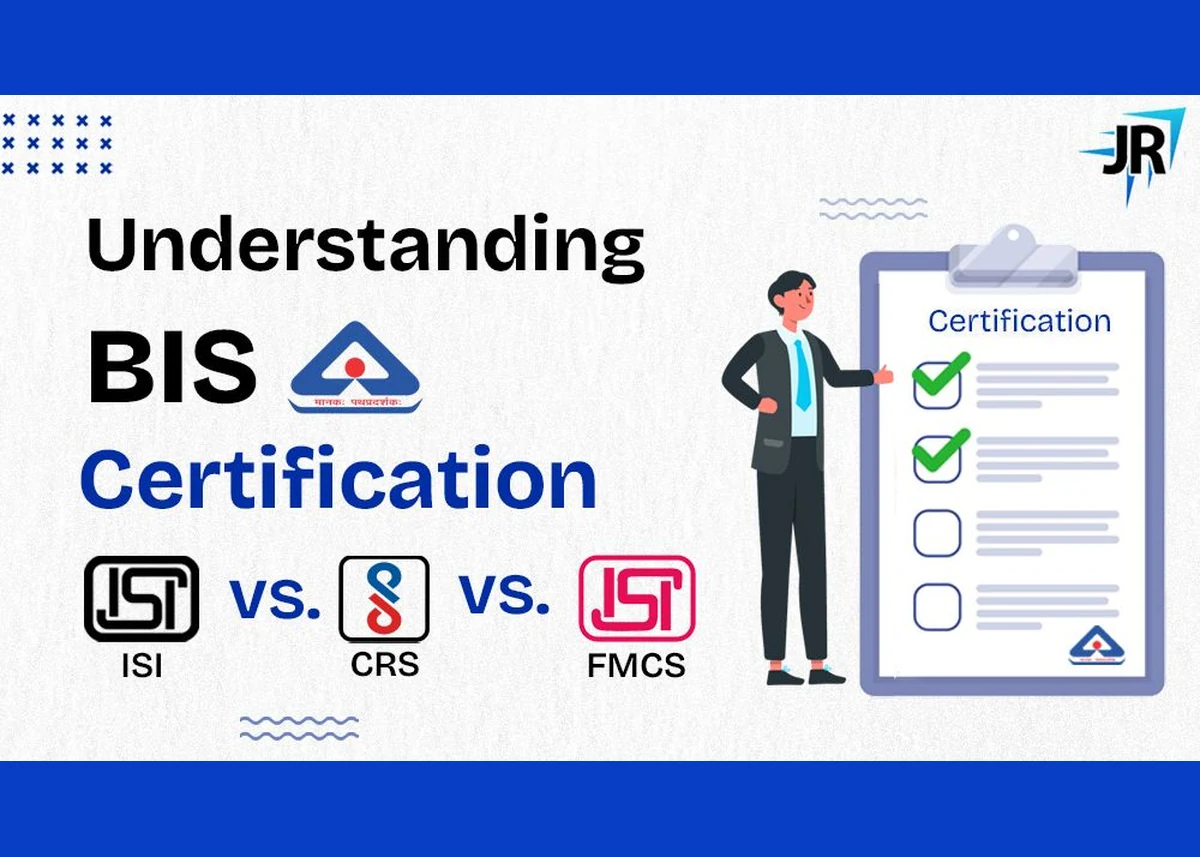
BIS certification is mandatory for more than 450 types of products ranging from simple electrical goods to complex heavy industrial products. The BIS certification is used to ensure that businesses can guarantee their products conform to safety and quality standards. Three certifications, such as ISI, CRS, and FMCS applicable to respective circumstances and purposes, are issued by the BIS.
In this blog, we will break down what each ISI, CRS, and FMCS certification means, how they differ from one another, and how businesses can navigate these requirements to be successful in the Indian market.
Overview of BIS Certifications
BIS certification has approximately 1118 products categories in which 380 are mandatory and 738 can be applied for voluntarily under it, extending from household consumer goods and electronic gadgets to food products and even industrial machinery. Over at JR Compliance, we streamline the process while ensuring that all your regulatory needs are met.
The BIS has three general certifications:
1. Indian Standards Institute (ISI) certification:
Contains more than approximately 341 product types require mandatory ISI certification, such as electrical goods, steel, and cement, require an ISI mark certification. The mark will guarantee the 100% safe product, and consumers trust in the products marked with the logo in the Indian market.
2. Compulsory Registration Scheme (CRS) Certification:
This scheme covers approximately above 77 specific types of categories which require mandatory CRS certification mainly in IT sector and electronics, thereby ensuring standards relating to performance, as well as safety. 30% of total electronics imported into India are covered under CRS certification.
3. Foreign Manufacturer Certification Scheme (FMCS)
FMCS focuses on foreign manufacturers, to ensure that the goods they export to India meet the Indian safety standards. In the last ten years, over approximately 10,000 foreign companies sought FMCS certification, which is a testimonial to the fact that demand for global products is on an increase in India.
The Key Differences Between ISI, CRS, and FMCS
Let’s dive into the main differences between these certifications. The table below simplifies the comparison based on scope, certification process, and costs.
Process of procuring the certificates and registration process
Navigating the certification process can be complex. Below is a simplified flow of how businesses can procure each certification:
-
ISI Certification
- Application Submission
- Product Testing
- Factory Inspection
- Test and Inspection Report Review
- Grant of License
- Post-Certification Monitoring
-
CRS Certification
- Identify Product Category
- Product Testing
- Application Submission
- Application Review
- Grant of Registration
- Post-Certification Monitoring
-
FMCS Certification
- Identify Standards
- Submit Application
- Factory Inspection
- Product Testing
- Grant License
- Ongoing Monitoring
Areas of Overlap
Products Covered Under Each Certification
Understanding which products fall under each certification is vital. Below is a summary of product types commonly associated with each certification:
Overlaps and Shared Products
Products like electrical appliances and electronics might require both CRS and ISI certification, depending on their origin. Domestic products might need ISI certification, while similar imported products would require CRS and FMCS certifications.
What to Do in Case of Overlaps
When encountering overlaps, it is crucial to determine the specific certification requirements based on the product’s origin and intended market. Businesses should ensure compliance with all relevant certifications to avoid regulatory issues and enhance market access.
Some products fall under more than one certification scheme. For example:
- Electronics may need both ISI and CRS certifications, depending on the product category.
- Imported electrical appliances might require both CRS and FMCS certifications.
Case Study: A Real-Life Example
Product: Imported Electrical Appliance
Certifications Needed: CRS for safety and FMCS for compliance with Indian standards.
Process:
- Register the product under CRS.
- Submit product samples for testing.
- Apply for FMCS certification to ensure compliance with Indian standards for imports.
The manufacturer brought the product to market in under six months after ensuring compliance with both certifications.
The repercussions of Non-Compliance
Without proper certification by BIS, your business may be subject to hefty penalties, product recalls or even a ban on the Indian market. According to a recent survey, 30% of businesses fail to get the required BIS certification and incur losses of 10-15% from market exclusion.
Why does BIS Certification Matter?
BIS certification is highly important for any business that sells or imports commodities in India. Not only, this will ensure legality, but also it enhances the credibility of your brand and opens up a fast-changing market.
Do you need assistance in determining which BIS certification can be used for your products? JR Compliance offers easy access through various intricacies of BIS certification processes. A domestic company or an international firm seeking entry into the Indian market will be guided and supported through the best Certification Consultants as you navigate all the procedures to ensure complete compliance with the most up-to-date regulations.
Contact us today to know more about our full certification services in India and how we can help you with BIS registration!